

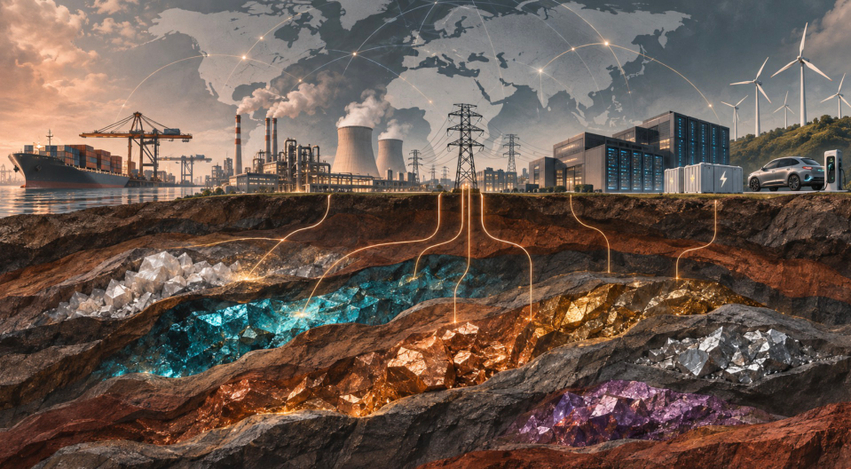
For more than a century, oil has been one of the main sources of economic and political power. But in the era of artificial intelligence, electric cars and advanced technologies, another group of raw materials is gaining strategic importance. Lithium, cobalt, copper and rare metals are changing relations between states. And the battle is not only over what lies underground, but above all over what happens after the minerals are extracted from it.
If we were looking for a symbol of world power during the 20th century, we would probably choose an oil well.
Oil moved armies, supplied factories, determined alliances, and could plunge entire economies into crisis. Countries that possessed large reserves or controlled its transportation routes had an extraordinary instrument of influence in their hands.
But in the 21st century, the map of power is becoming more complicated.
An electric car needs specialized batteries and motors. A data center that supports artificial intelligence requires vast amounts of copper, electronics, and power. Wind turbines, fighter jets, industrial robots, and many other advanced systems depend on materials that most people know very little about.
Some of them have almost unknown names: neodymium, praseodymium, dysprosium, terbium. Others are more familiar: lithium, nickel, cobalt, copper.
It's all part of a transformation that is changing the global economy. But contrary to what one might think, the countries that own minerals are not necessarily the ones that control their trade.
In this difference lies one of the greatest paradoxes of modern geopolitics. Wealth may lie beneath the soil of a country, while the economic power that emanates from it may be thousands of kilometers away.
Underground wealth is not enough
The Democratic Republic of Congo is one of the most significant examples. According to data published in June 2026 by the United Nations Conference on Trade and Development, UNCTAD, the country produced about 74 percent of the world's mined cobalt in 2025.
Cobalt is used in several types of batteries, in metal alloys, and in industrial applications with specific technical requirements. At first glance, such a large concentration of production should give Congo an extremely powerful position in the world economy. But the story does not end with the mine.
Before cobalt can be transformed into a suitable material for batteries, it must be processed, refined, and passed through a complex production chain.
Much of this processing takes place outside Congo, particularly in China. This means that the country that extracts the mineral and the country that transforms it into an industrial product wield two different kinds of power.
The first controls the natural resource. The second controls a crucial part of the road that makes the resource usable.
Owning a mineral reserve is not the same as owning the factories, technology, expertise, and trade networks that turn it into a product. In the world, power doesn't just come from what you have. It also comes from what you're able to do with it.
The advantage China built over decades
At the center of this story is China. Over the past few decades, Beijing has built up vast capacities for the extraction, processing, and production of strategic materials. The result is a very strong position in some of the most important links in the supply chain.
According to the International Energy Agency's "Global Critical Minerals Outlook 2026" report, China accounts for over 90 percent of the global refined supply for several materials, including gallium, graphite and manganese, as well as certain categories of rare earth elements. For rare earth metals used in powerful magnets, the concentration is particularly high.
These magnets are found in a wide range of technologies, from electric motors to industrial systems and defense equipment. But this position was not created simply because China possesses mineral reserves.
It is the result of industrial investments, infrastructure, technological expertise, state policies, and the development of a manufacturing ecosystem that is difficult to reproduce within a few years.
Mineral processing requires specialized knowledge, energy, equipment, and often expensive chemical processes. Even when another country opens a new mine, it may have to ship its product overseas for processing.
That's why Western countries are discovering that opening mines is not enough to reduce dependence. They also need to build up the entire industry that lies between the mine and the final product. And that may take much longer than a diplomatic agreement.
From oil to magnets
For decades, energy security mainly meant guaranteeing the supply of oil and gas.
States struggled to secure reliable producers, transportation routes, and strategic reserves.
Today, some of this logic is being extended to minerals. But there is an important difference.
Oil is constantly consumed as fuel. A large proportion of minerals, by contrast, is used to build equipment that can last for years and whose materials can, in some cases, be recycled. This means that the minerals economy is not a carbon copy of the oil economy.
However, strategic dependencies can be just as serious. Imagine an electric car factory that can produce almost all the parts of the vehicle but doesn't have access to a small, essential component for the engine. The entire production line could be disrupted.
Or a defense industry that possesses the technology to build an advanced system but depends on a single supplier for a specialized material. In these cases, the importance of a raw material is determined not only by its price or quantity, but by the question: what happens if it is missing?
A relatively cheap material can be of enormous strategic importance if no suitable substitute exists. Thus, part of modern economic power may lie in controlling the less visible components of production.
A world striving to reduce addiction
The United States, the European Union, Japan, Australia and other partners are trying to create more diverse supply chains.
The goal is to avoid becoming overly dependent on a single country for materials deemed essential to the economy and national security. But diversification is not a simple process.
A new mine can require years of geological exploration, investment, environmental permits, and infrastructure construction.
A processing plant requires not only capital, but also specialists, technology, and a stable supply of raw materials.
Furthermore, private companies do not always invest in projects that are of strategic importance to states if the expected profits do not justify the economic risk.
Here arises a new tension between the logic of the market and the logic of national security. A country may want a domestic processing industry even if imported materials are cheaper. A company, on the other hand, may prefer the most economical supplier, regardless of geopolitical risk.
In an analysis published in Foreign Affairs on November 4, 2026, Tom Moerenhout and Kevin Brunelli place investment at the center of the debate over critical minerals and the efforts of the United States and its allies to compete with China.
The problem is not simply identifying the missing minerals. It is building an economic system capable of producing and processing them sustainably.
The new powers of the underworld
In this race, countries that have long been seen primarily as exporters of raw materials are seeking a bigger role. Indonesia is a notable example. According to UNCTAD, it accounted for about 67 percent of global nickel production from mines in 2025. Nickel is important for the production of stainless steel and for some battery technologies.
But Indonesia does not want to limit itself to selling raw minerals. Through policies aimed at developing domestic industry, it has sought to attract investment in processing and manufacturing. This strategy brings economic opportunities, but also controversy. Restrictions on the export of raw materials can encourage domestic processing, while at the same time creating trade conflicts and costs for international partners.
Moreover, building new industries requires energy and can have significant environmental consequences. However, the Indonesian example shows that the geography of power is not fixed. A country that owns natural resources can strive to move up the value chain, rather than remaining a mere supplier of raw materials. This is one of the most important aspirations of mineral-rich countries in Africa, Asia and Latin America.
The question is whether they will succeed in converting geological wealth into industrial capacity and long-term development.
The dark side of technological transition
There is a contradiction that cannot be left out of this story.
Many of the minerals being raced for are needed for technologies aimed at reducing greenhouse gas emissions.
But their extraction and processing can cause environmental damage, water pollution, habitat destruction, and conflicts with local communities.
In some regions, problems are also related to working conditions, workers' rights, and the transparency of the mining industry.
An electric car may have climate benefits during its use and life cycle, but that does not automatically make the supply chain of materials used to produce it harmless.
That's why the race for critical minerals cannot be assessed solely in strategic terms. It also raises a moral question. If rich countries seek cleaner technologies, who should bear the costs of extracting the materials that make them possible?
And how can it be ensured that producing countries receive sustainable economic benefits, rather than remaining exposed to pollution and international price fluctuations?
In this sense, the future of minerals is not just a matter of rivalry between superpowers. It is also a test of how the global economy distributes wealth, risk, and responsibility.
What does this mean for Europe and the Balkans?
For the European Union, dependence on imports of critical raw materials has become a major industrial policy issue. Europe possesses advanced technological capabilities and a large market, but for many strategic materials it depends on suppliers outside the continent.
This has increased interest in mining projects, processing, recycling and agreements with partner countries. In this context, the Balkans could also gain strategic importance. The region has mining traditions, various metal reserves and geographical proximity to European industry.
But this does not mean that every mining project is automatically a development opportunity. The economic importance of a resource depends on the quality of the reserves, extraction costs, infrastructure, environmental impact and the possibility of creating a processing industry.
For Albania and other countries in the region, the question should not simply be how many minerals are found underground. The more important question is what economic and social value can be created from them.
A country can export raw materials for decades without building a developed industry. It can create short-term income, but remain dependent on international prices and the decisions of foreign companies.
On the other hand, a well-thought-out industrial policy can link natural resources with processing, vocational education, technology, and domestic production. The difference between these two paths is not only economic, but also political. Because it determines how much control a country has over its future.
The real power lies in the chain.
In the 20th century, much of geopolitics could be explained by looking at oil fields and sea routes. In the 21st century, we must also look at lithium mines, cobalt refineries, magnet factories, processing plants, and the ports through which materials pass.
But above all, we need to understand the connections between them. One country may have the minerals, but not the technology to process them. Another may have the factories, but not the natural resources. A third may have the capital, the patents, and the final market. None are completely independent.
The race for critical minerals is therefore not just a race for ownership of resources. It is a race to determine who controls the crucial links of production and who is able to continue to function even when international relations deteriorate.
In this world, geopolitical influence is not measured just by territory, economic size, or military might. It is also measured by the ability to produce the things that other economies cannot function without. And this may be one of the most important changes of our era.
For centuries, people have fought for the land they could conquer. Today, competition is increasingly focused on what the land hides, the technology that brings it to the surface, and the industry that turns it into power. / Source: “The Shifting Dynamic of Critical Minerals Trade”


